
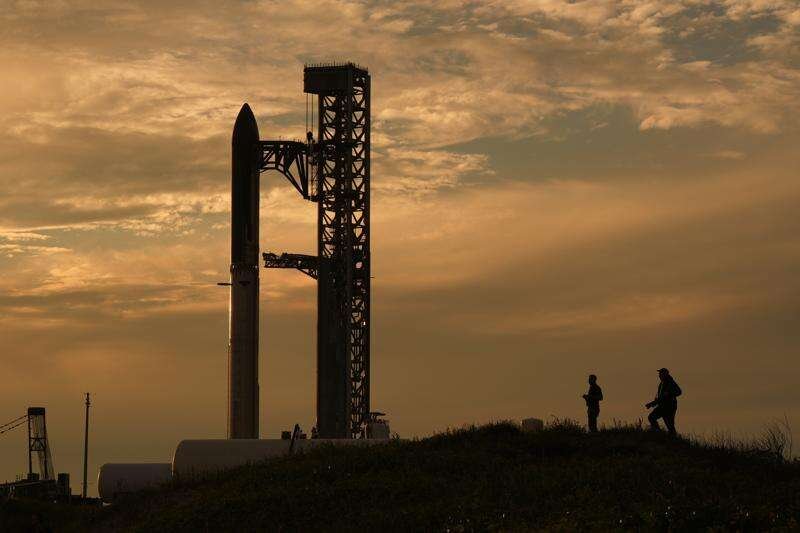
SpaceX's Starship has successfully reached orbit, but its booster exploded after a catch attempt was aborted during a test flight from Starbase, Texas, on Friday. The spacecraft will steer toward the launch pad Saturday, barring further trouble, in its boldest test yet.
At a Glance
- SpaceX's Starship reached orbit despite a booster explosion that prevented a double catch.
- The booster was diverted to a point offshore after the explosion, but the spacecraft continued on its way.
- The flight could last as long as 22 hours, with the spacecraft completing 15 laps around the world at an altitude of around 170 miles.
Starship's Orbital Success
SpaceX's Starship successfully reached orbit on Friday, marking a significant milestone for the company's ambitious space program. The spacecraft, which spans 171 feet, will complete 15 laps around the world at an altitude of around 170 miles.
The orbital success is a major achievement for SpaceX, which has been working towards establishing a presence in space. The company's goal is to use Starship to send people to the moon and Mars, and this test flight is a crucial step towards achieving that goal.
Booster Explosion and Catch Attempt
However, the test flight was not without its challenges. The booster for the Starship exploded after a catch attempt was aborted, preventing SpaceX from retrieving the entire rocket. The explosion occurred after the booster was diverted to a point offshore.
The loss of the booster meant that SpaceX missed out on a double catch, which would have been a significant achievement for the company. However, the spacecraft continued on its way, and the company is optimistic about the test flight's outcome.
Industry Context and Next Steps
The test flight is part of SpaceX's broader efforts to develop a reusable rocket system. The company has already made three booster grabs at its Starbase facility near the U.S.-Mexico border, and this test flight is a crucial step towards achieving its goals.
The success of the test flight will have significant implications for the space industry, which is increasingly looking towards reusable rockets as a way to reduce costs and increase efficiency. SpaceX's Starship program is seen as a key player in this trend, and the company's success will have far-reaching consequences for the industry as a whole.
What to Watch Next
The spacecraft will steer toward the launch pad Saturday, barring further trouble, in its boldest test yet. The flight could last as long as 22 hours, and the company is optimistic about the test flight's outcome.
The success of the test flight will be closely watched by industry observers, who will be eager to see how SpaceX's Starship program unfolds. The company's goal is to use Starship to send people to the moon and Mars, and this test flight is a crucial step towards achieving that goal.
Have a news tip, press statement, or correction request? Reach the EmailTrump News Newsroom or review our Editorial Standards & Corrections Policy.
About the Author