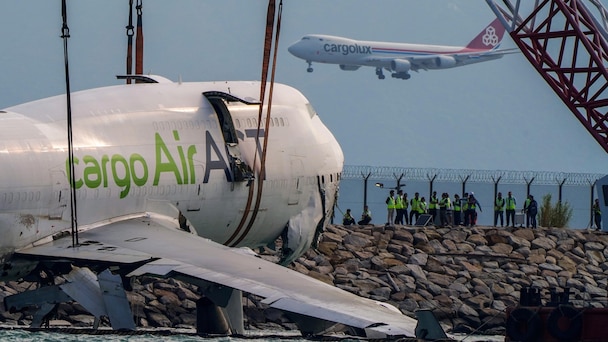
Could a single engine error be responsible for a tragic accident claiming two lives, even when everything else seemed normal? The preliminary findings into last month’s deadly plane crash in Hong Kong have revealed a startling detail: one of the aircraft’s engines inexplicably accelerated after landing. This critical discovery comes from the Air Accident Investigation Authority’s report, which classified the incident as an accident. Despite normal weather, runway conditions, and air traffic control, the Boeing 747, operated by Turkey-based ACT Airlines and leased by Emirates, tragically skidded off the runway on October 20th. It then collided with a security patrol car, plunging both vehicles into the sea and killing two workers inside the car, while the four crew members on board remained unharmed. Investigators found that thrust levers for three engines were correctly closed and in reverse, but the Number 4 engine’s thrust lever was in the full forward position, indicating acceleration. The Transport and Logistics Bureau stated that the ongoing probe will now intensely focus on understanding why that specific engine’s thrust lever was positioned for full forward thrust. Experts from Turkey, the U.S. National Transportation Safety Board, and Boeing are assisting the authority in gathering further data on aircraft systems, engine conditions, maintenance, and human factors. This deep dive aims to uncover the full truth behind the mysterious engine behavior and prevent future tragedies. Don’t miss future updates on this unfolding investigation; make sure to subscribe to our channel for the latest developments and in-depth analysis.
Follow us on social media:
– X: @BollyMirch
– Instagram: @bollymirch
📱 Tags & Keywords:
#hongkongplanecrash #engineacceleration #aviationaccident #boeing747 #actairlines #airaccidentinvestigationauthority #preliminaryreport #flightsafety #aircraftinvestigation #deadlycrash
About the Author